
Start
June 1st 2025
End
November 30th 2028
17 partners
including 1 associated partner
8 countries
7 EU countries & Canada
3 pilot sites
Madrid (Spain), Trieste (Italy), Varna (Bulgaria)

Project Overview
Gathering 17 partners including 1 associated partner across Europe and Canada, MODALSHIFT is a 42-month Horizon Europe project that aims to optimise multimodal and traffic management for an efficient transport network and seamless door-to-door mobility of passengers and freight.
Ten developed solutions (TRL5-6) will be validated in real transport operations in three case studies to demonstrate reliable performance, user acceptance and measurable impact on mobility efficiency and sustainability.
Check our first presentation video
of our MODALSHIFT project !
Actualities
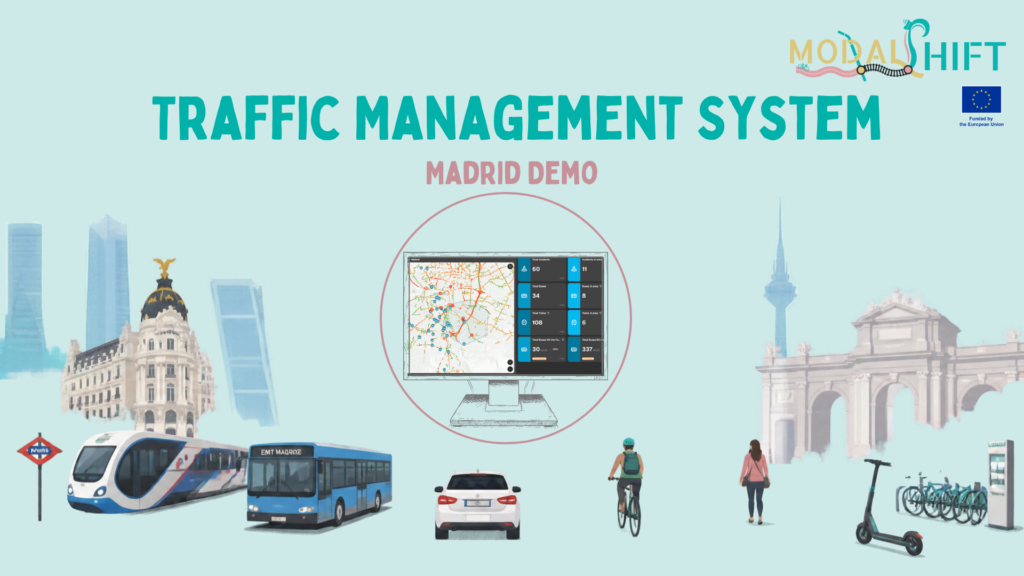
MODALSHIFT reaches a major technical milestone with the first version of its Traffic Management System

MODALSHIFT at the CIVITAS Forum 2026 in Thessaloniki

What happened during the 2026 summer?
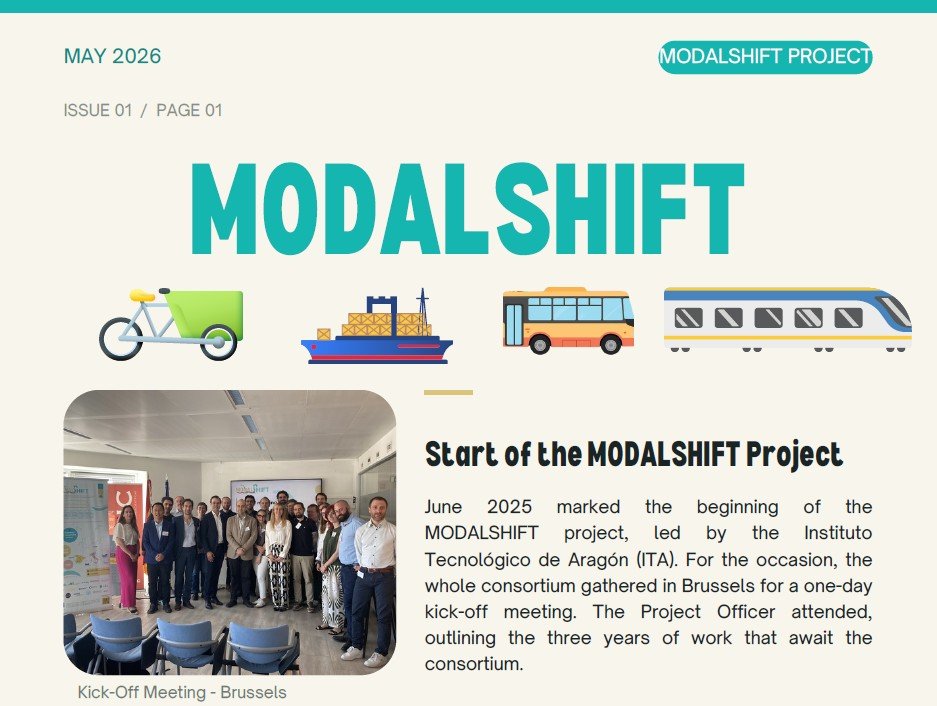
Modalshift first newsletter !
MODALSHIFT Press release

[HERALDO] New ways of travelling: from shared mobility to inter modal systems
Data reminder
The Modalshift project places GDPR (General Data Protection Regulation) and the upcoming EU AI Act at the forefront of its considerations regarding data access and usage. This is paramount because data sharing is a key and central aspect of the project.
The GDPR is a landmark EU law that came into effect in 2018, designed to protect the personal data and privacy of EU citizens. It sets out strict rules for how personal data must be collected, stored, processed, and shared, emphasizing principles like lawfulness, fairness, transparency, purpose limitation, data minimization, accuracy, storage limitation, and integrity and confidentiality. It also grants individuals significant rights over their data, including the right to access, rectification, erasure (the « right to be forgotten »), and the right to object to processing.
The EU AI Act, the world’s first comprehensive legal framework for Artificial Intelligence, addresses the risks associated with AI systems. It adopts a risk-based approach, categorizing AI systems into different risk levels (unacceptable, high, limited, and minimal) and imposing corresponding obligations on providers and deployers.
For « high-risk » AI systems, which include those used in critical infrastructure, education, employment, law enforcement, and other sensitive areas, the Act mandates strict requirements around data governance, risk management, human oversight, transparency, robustness, and cybersecurity.
Our commitment is to ensure that all data access and usage within Modalshift adhere to these frameworks, fostering trust and ensuring responsible data sharing while leveraging the power of data and data-centric solutions for positive impact.
Where possible, data anonymization is applied to ensure that manipulated data and models cannot leak any information about individuals.
Subscribe to the newsletter
Subscribe to our newsletter to receive all our latest news via your inbox!